
Most people think muscle loss is about appearance.
Losing tone. Gaining weight. Looking older.
That’s how it’s usually framed—in conversations, in media, even in health advice.
But that framing misses what matters most.
Because muscle isn’t just about how you look. It’s one of the primary systems that determines how you function—how much energy you have, how well your body recovers, and how long you remain independent.
And over time, that system begins to decline.
Not in a way that feels urgent.
Not in a way that demands immediate attention.
But slowly enough that it becomes easy to ignore—until it starts shaping what you can and can’t do.
Muscle Is Not Just Tissue—It’s an Energy System
To understand muscle decline, you have to look beyond the surface.
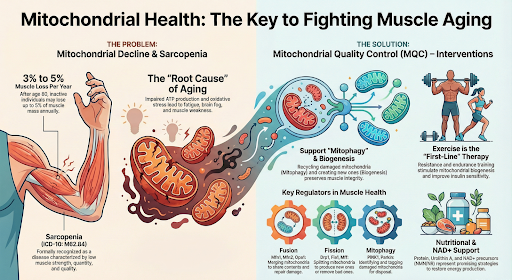
Inside every muscle cell are mitochondria—structures responsible for producing energy.
They convert nutrients into ATP, the fuel your body uses for:
- Movement
- Balance
- Stability
- Recovery
- Even aspects of cognitive function
This is why muscle plays a much larger role than most people realize.
It’s not just about strength.
It’s about capacity.
Capacity to move, to adapt, to recover, and to stay engaged in daily life without limitation.
What Actually Changes With Age
As you get older, several shifts happen at once—and they reinforce each other.
Mitochondria begin to lose efficiency.
Energy production declines.
The body becomes slower at repairing damaged cells.
At the same time:
- Muscle mass gradually decreases
- Strength declines at an even faster rate
- Recovery becomes less predictable
These changes don’t happen in isolation.
They create a compounding effect.
Less energy leads to less movement.
Less movement leads to further decline.
And because this cycle builds slowly, it rarely gets addressed early.
Why This Decline Often Goes Unnoticed
One of the reasons muscle decline is so common is that it doesn’t feel like a problem—at least not at first.
It shows up in subtle ways:
- Taking longer to recover after activity
- Feeling slightly more fatigued during the day
- Avoiding tasks that require effort without thinking about it
These small adjustments don’t seem significant.
But over time, they become patterns.
And those patterns quietly reduce your physical capacity.
From “Normal Aging” to Measurable Decline
For years, muscle loss was considered a normal part of aging.
Something expected. Something inevitable.
That perspective has changed.
Age-related muscle loss—sarcopenia—is now classified as a disease.
That shift reflects a deeper understanding:
This is not just aging.
It is a measurable and progressive loss of function.
Research shows:
- Muscle mass declines by approximately 1–2% per year after age 50
- Strength declines faster than muscle mass
- Total loss can reach up to 30–50% over time
The key point is not just that loss occurs.
It’s that it accumulates.
Energy Capacity Is What You Feel Day to Day
Most people think strength is about effort.
But effort depends on energy.
Mitochondria produce ATP—the energy your body relies on for:
- Muscle contraction
- Brain activity
- Cellular repair
When ATP production declines, the effects become noticeable:
- Tasks feel heavier than they used to
- Endurance drops
- Recovery takes longer
This is why simply “trying harder” often doesn’t lead to better results.
If the system producing energy is compromised, output will always be limited.
The Hidden Problem: Declining Repair Systems
Your body has a built-in process for maintaining cellular health.
Damaged mitochondria are removed and replaced through a process called mitophagy.
But with age, this process slows down.
Instead of clearing out inefficient components, your body begins to accumulate them.
Over time, this leads to:
- Reduced energy efficiency
- Increased oxidative stress
- Declining muscle performance
It’s not just that the system is aging.
It’s that maintenance is no longer keeping up.
Why Activity Level Changes the Outcome
Two people can age at the same rate chronologically—but very differently physically.
One remains active, capable, and independent.
The other experiences steady decline.
A major factor behind this difference is how well the body continues to use energy.
Research often highlights what’s called the “athlete’s paradox”:
- Both active and inactive individuals may store fat in muscle
- Active individuals use it efficiently
- Inactive individuals do not
The difference is not storage.
It’s utilization.
And utilization depends on how often the system is engaged.
Exercise Is Not Just Effort—It’s System Repair
One of the most overlooked facts about exercise is this:
It doesn’t just burn energy.
It helps rebuild the system that produces it.
Strength and resistance training stimulate mitochondrial biogenesis—the creation of new mitochondria.
This leads to:
- Improved energy production
- Better endurance
- Greater metabolic flexibility
And importantly, these changes can happen even without visible weight loss.
Which means the real benefit of exercise isn’t just what you see.
It’s what your body becomes capable of doing.
The Cost of Losing Strength Goes Beyond the Physical
Muscle decline doesn’t stay confined to the body.
It begins to affect how you live.
Over time, reduced strength leads to:
- Higher risk of falls
- Limited mobility
- Reduced independence
- Increased reliance on others
- Rising healthcare costs
These outcomes are rarely sudden.
They are the result of long-term, unaddressed decline.
How This Progression Typically Unfolds
Because the process is gradual, it often feels like “just getting older.”
But the pattern is consistent:
In your 50s
- Everyday tasks feel slightly more demanding
- Recovery becomes less efficient
In your 60s
- Certain movements are avoided
- Strength feels less reliable
In your 70s and beyond
- Assistance becomes necessary
- Confidence in physical ability declines
The important point is not the timeline.
It’s the trajectory.
And trajectories can change.
Making Strength Visible
Before you can improve anything, you need to measure it.
Simple indicators can provide clarity:
- Sit-to-Stand Test
Measure how long it takes to complete 10 repetitions without using your hands - Weekly Strength Frequency
Track how many days include intentional strength work - Carry Capacity Check
Assess whether you can carry moderate weight without strain
These are not performance metrics.
They are awareness tools.
A Practical Starting Point
Most people delay action because they think they need the perfect plan.
They don’t.
They need a consistent starting point.
Within the next 48 hours:
- Schedule two strength sessions
- Use bodyweight exercises, resistance bands, or light weights
- Keep sessions to 20–30 minutes
No optimization required.
No complexity needed.
Consistency is what drives change.
Why Structure Changes Outcomes
The difference between decline and stability often comes down to one thing:
Structure.
Without it:
- Activity becomes inconsistent
- Strength exposure is limited
- Decline continues
With it:
- The body receives regular signals to adapt
- Energy systems are maintained
- Capacity improves over time
Most people don’t lack information.
They lack a system that makes consistency easier to sustain.
Final Thought
Your muscles are not just responsible for movement.
They are the foundation of your energy, your resilience, and your independence.
So the question isn’t whether aging will affect your body.
It’s this:
Are you actively maintaining your capacity
or assuming it will maintain itself?
